Skip to content

Discovery software for high-purity water

Leave the meeting with a plan.

Eighteen2 turns the first customer meeting into a complete, standards-checked package: the treatment system drawn, the equipment named, the demand sized, a P&ID, and a submittal. Your engineer reviews a finished draft instead of starting from a phone call.

30-day trial, no credit card required. Existing customers: Log in. To discuss your team's requirements, contact sales.

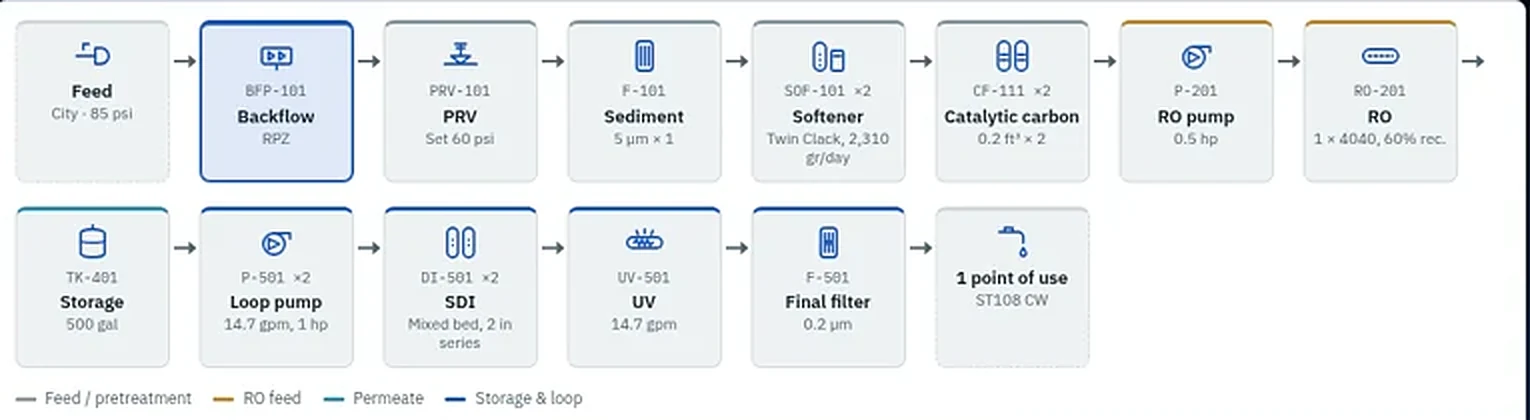
Eighteen2 Build tab showing a two-row treatment train from city feed through backflow, PRV, sediment, softener, catalytic carbon, RO, storage, loop pump, DI, UV, and final filter, with the backflow preventer's detail panel open below.
  • TaggedEvery component in the flow path, in order
  • SourcedPart numbers linked to the maker's page
  • One recordP&ID, BOM, and submittal always agree
The treatment train for a sterile processing department, tagged component by component, from city feed to the point of use.
Designed against
  • AAMI ST108
  • CLSI GP40
  • ASTM D1193
  • USP Purified Water
  • CAP checklist

What we do

One meeting in. A complete package out.

Everything the engineer needs to review, and everything the customer needs to sign, built from a single record so the drawing, the parts list, and the submittal always agree.

  1. Flow path

    The treatment train drawn in order, from the city feed and backflow preventer to the last point of use, with every component tagged.

  2. Equipment named

    Each step resolved to a manufacturer and part number, with its source shown: verified, suffix to confirm, or spec-and-quote.

  3. Demand sized

    Gallons per cycle, cycles per day, and peak flow for the equipment the system feeds, carried through to RO capacity, storage, and loop size.

  4. Chain of custody

    Customer, rep, and engineer each confirm their own step. The clock runs from one handoff to the next, so every handoff is timed.

  5. P&ID

    A piping and instrumentation diagram with a title block, line list, and instrument tags, ready to print or attach.

  6. Spec check

    The design is checked against the standard the site names. Under-design is flagged, and so is over-design the job does not need.

  7. Submittal

    Transmittal, compliance matrix, schedules, product data index, deviations, and closeout, assembled from the same record.

Applications

  • AAMI ST108

    Sterile processing

    Critical and utility water for washer-disinfectors, sterilizers, and endoscope reprocessing, with the monitoring plan the standard expects.

  • CLSI GP40 · CAP

    Clinical laboratory

    Clinical laboratory reagent water (CLRW) and special reagent water for analyzers, with the analyzer maker's feed spec carried alongside.

  • ASTM D1193

    Laboratory reagent water

    Type I, II, and III systems for research and QC labs, sized to the bench and polished at the point of use.

  • USP Purified Water

    Pharmaceutical

    Purified Water generation and distribution with conductivity and TOC monitoring at the loop return.

  • Equipment spec

    Boiler feed and light industrial

    Softened, RO, and CEDI makeup sized to the boiler or process maker's own water table.

How it works

Seven screens in the meeting. A signed scope after it.

The workspace asks what an applications engineer would ask, in the order they would ask it. You name the equipment the water feeds first; those loads set quality and volume before you size the train.

  1. Start

    Project, location, room, the customer contact, and the rep. The project link goes to the contact named here.

  2. Application

    Sterile processing, clinical lab, reagent water, pharmaceutical, or boiler feed, and the grade the site has to meet.

  3. Equipment

    The washers, sterilizers, analyzers, or boilers the water feeds. Name those first; their quality and volume needs drive the demand step next.

  4. Demand

    Gallons per day, peak draw, points of use, and loop length, carried straight into RO capacity, storage, and pipe size.

  5. Feed water

    Source, TDS, hardness, iron, temperature, and pressure: the inputs that decide pretreatment.

  6. Site

    Power in the room and pipe material: the details that sink a proposal when they surface late.

  7. Anything else

    Service, parts, or a need this project does not cover, routed to the person who owns it instead of lost in notes.

After the meeting

  1. Build

    The system is drawn, equipment is named, and the design is checked against the standard — every assumption stays on screen.

  2. Hand off

    The finished package goes to engineering. The engineer revises it and sends it back approved, or with notes.

  3. Confirm and quote

    The customer confirms the returned package. Your team writes the quote in its own system; Eighteen2 does not price the job.

Eighteen2 Service

Field service on the same platform.

Eighteen2 Service is for the technician on site: a quick visit or a full train walk, with readings, photos, and items to quote, saved to your team's account as the visit progresses.

  • Quick visit or full walk

    A quick visit asks for the symptom, the surface check, readings, and the components you touched. A full visit walks the whole train in order.

  • Saved for the team as you go

    Visits save to your company's account, not the phone. Anyone on the team can pick one up. If two people edit at once, you are told; nothing is silently overwritten.

  • Photos and site history

    Photos attach to the component they show. Each system keeps its visit history, so this visit's readings sit next to the last one's.

  • A report the customer can open

    Print it, or send the customer a read-only link you can turn off later. Each quote goes to its own inbox, Engineer, Sales support, or Aftermarket, and the team is emailed when one arrives.

Included with every plan and the trial. On a phone, bookmark service.eighteen2.com. Open Eighteen2 Service

Pricing

A subscription for the team that quotes.

Priced by seat, for dealers, integrators, and manufacturers' reps. Customers never need a seat: they open their project from a link.

  • Solo

    $99 per month

    or $990 per year

    One seat, monthly or yearly

    One rep or applications engineer quoting on their own.

    • Every application and standard
    • P&ID, spec check, and submittal
    • Customer project links, no customer seat needed
    • Service field visits, reports, and quote inboxes
    • Reference sheets and catalog updates
    Start a 30-day trial
  • Company

    Custom annual license

    For 13 or more seats

    Volume pricing, multi-branch terms. License covers up to 15 seats; more by agreement

    Larger teams, multiple branches, or a manufacturer's rep network.

    • Everything in Team
    • Your own supplier list and catalogs
    • Onboarding with the Eighteen2 team
    • Terms set with your team directly
    Contact sales

Prices in USD, before tax. Already have an account? Choose a plan in your account. Prefer to see it first? Take the guided demo.

  • Seats for the people who quote

    Reps and applications engineers each get a seat. Customers confirm through a project link and do not need one.

  • Continuity across the team

    Saved systems, supplier choices, and contact cards belong to the team, so a job does not stall when someone is out.

  • A clock on every package

    Handoff times are recorded as the work happens. Over time, the floor view becomes your own record of how discovery runs.

  • Support from people who know the work

    Questions go to a team that has installed and serviced these systems for years.

FAQ

Questions we hear at the first meeting.

Something else? Write to contact.us@eighteen2.com.

What is Eighteen2?

Discovery software for high-purity water. It turns the first customer meeting into a complete package: the system drawn, the equipment named, the demand sized, a P&ID, a spec check, and a submittal, with every handoff timed. The quote is still written in your own system.

Does Eighteen2 replace my engineer?

No. It does the first-draft work: sizing, parts, P&ID, spec check, and submittal layout, with every assumption shown. Your engineer still reviews, changes, and approves the design. The point is that they start from a complete draft instead of a blank page, so each proposal takes less of their time.

Are the designs engineered or stamped?

No. Eighteen2 produces budgetary designs for estimating and proposals, and labels them that way. A licensed engineer or the equipment manufacturer confirms the final design.

Where do prices come from?

Eighteen2 lists part numbers, not prices. RFQs go to your suppliers from your inbox. Price and lead time come back from the supplier, into the quoting system you already use.

Which applications and standards does it cover?

Sterile processing to AAMI ST108, clinical laboratories to CLSI GP40 with CAP checklist items flagged, laboratory reagent water to ASTM D1193, pharmaceutical Purified Water to USP, and boiler feed and light industrial water to the equipment maker's own spec.

Which suppliers are included?

Equipment makers such as Xylem/Evoqua, DuPont FilmTec, Aquafine, Grundfos, and Veolia, and parts suppliers such as Harrington, Ryan Herco, Watts, and GF Signet. You choose which catalogs supply your builds and star the vendors you have agreements with.

Can my whole team use it?

Yes. Eighteen2 is built for teams that share an applications engineer. Reps build the draft, the engineer reviews and approves it back, and the floor view shows where jobs wait. Saved systems are shared across the team.

What does my customer see?

A project link. The customer confirms each section of the discovery from that link before it can go to engineering, and confirms the return when the package comes back. They do not need an account.

How do I get started?

Eighteen2 is a subscription by seat: Solo for one person, Team for reps who share an engineer, and a Company license for 13 or more seats. Take the guided demo, then start a 30-day trial: every feature, up to 3 seats, no credit card required. When the trial ends without a plan, the account becomes read-only and nothing is deleted. For a Company license, contact sales and our team will reply within one business day.

What is Eighteen2 Service?

The field side of the same product. Technicians log site visits (readings, photos, what needs quoting) under the same account and team, and each quote goes to the Engineer, Sales support, or Aftermarket inbox, with an email to the team when it arrives. It is included with every plan. On a phone, bookmark service.eighteen2.com.

Do the reference sheets replace the standards?

No. They are working summaries for reps and engineers, checked against the standards by name. Standards are copyrighted and revised; buy the current edition and confirm limits against it, and against the equipment maker's instructions for use, before you bid.

Screens

See the work, not a mock-up.

A few screens from the designer, with demo data. The guided demo walks the whole flow.

Build. The flow path, tagged component by component. Each step opens to what it is, why it is there, and the part that fills it.
Sizing, sterile processing. AAMI ST108 critical water, sized from the washer it feeds. The spec check flags feed hardness on the utility water branch.
Sizing, clinical lab. CLSI clinical laboratory reagent water on exchange DI. Eighteen2 shows how often the worker bank exhausts at this feed, and what would change that.

Take the guided demo

Resources

High-purity water reference sheets.

The figures used most often in the field, one page each. Limits are drawn from the same standards record Eighteen2 checks designs against. Print them for the mechanical room.

Seven one-page references for the people who walk the mechanical room. Each prints on its own page.

Sterile processing

AAMI ST108 water quality

ST108 defines two water qualities for device reprocessing. Critical water is for the final rinse and anywhere water touches a device after cleaning. Utility water is for washing, flushing, and intermediate rinses.

Critical water
ParameterLimit
pH @ 25 °C5.0 – 7.5
Conductivity< 10 µS/cm
Total alkalinity< 8 mg/L as CaCO₃
Total hardness< 1 mg/L as CaCO₃
Bacteria< 10 CFU/mL
Endotoxin< 10 EU/mL
TOC< 1.0 mg/L
Chloride< 1 mg/L
Iron, copper, manganese, zinc, aluminum< 0.1 mg/L each
Nitrate, phosphate, sulfate, silicate< 1 mg/L each
Color and turbidityColorless, clear, no sediment
Utility water (washing, flushing, intermediate rinse)
ParameterLimit
pH @ 25 °C6.5 – 9.5
Conductivity< 500 µS/cm
Total alkalinity< 400 mg/L as CaCO₃
Total hardness< 150 mg/L as CaCO₃Soften above this unless detergent chemistry tolerates it.
Bacteria< 500 CFU/mL< 10 CFU/mL and < 10 EU/mL when used as final rinse after chemical HLD.
Chloride< 250 mg/L
Silicate< 50 mg/L

Steam

ST108 also addresses the water used to make steam for sterilization. Size the steam generator's feed to the sterilizer maker's instructions for use and the facility's water management plan, and record which source feeds which sterilizer.

Monitoring at a glance

  • Conductivity · Daily · After last treatment step
  • pH, alkalinity, hardness · Monthly · After last treatment step
  • Bacteria (HPC) and endotoxin (LAL) · Monthly · Loop out and loop return
  • pH, conductivity, alkalinity, hardness; bacteria and endotoxin · Monthly · First point of use (chemistry); each point of use (bacteria, endotoxin)
  • Utility water chemistry and bacteria · Quarterly · Treatment system and point of use

Frequencies are the standard's recommended minimums. A water management team and a documented risk assessment are expected.

AAMI ST108 (ST108:2023), Water for the processing of medical devices. Limits as summarized in the Eighteen2 standards record.eighteen2.com · Reference summary, not a substitute for the standard. Designs are budgetary.

Laboratory

ASTM D1193 reagent water, Types I–III

Types I, II, and III are defined by ionic, organic, and silica limits. Bacterial subtypes A, B, and C are optional add-ons; ask whether the customer's spec names one.

ParameterType IType IIType III
Resistivity @ 25 °C≥ 18.0 MΩ·cm≥ 1.0 MΩ·cm≥ 4.0 MΩ·cm
Conductivity @ 25 °C≤ 0.056 µS/cm≤ 1.0 µS/cm≤ 0.25 µS/cm
TOC≤ 50 µg/L≤ 50 µg/L≤ 200 µg/L
Sodium≤ 1 µg/L≤ 5 µg/L≤ 10 µg/L
Chloride≤ 1 µg/L≤ 5 µg/L≤ 10 µg/L
Silica≤ 3 µg/L≤ 3 µg/L≤ 500 µg/L
Final filtration0.2 µmNot specified0.45 µm

Rules of thumb

  • Type I is usually made at the point of use: an RO or Type II feed, then a mixed-bed polish, UV, and a 0.2 µm final filter.
  • Type II: older editions called for distillation; current editions accept any process that meets the limits. Confirm the customer spec does not still require distilled water.
  • Type III at 4 MΩ·cm is beyond RO alone. Plan a DI polish.
ASTM D1193 (D1193-06 (2018)), Standard Specification for Reagent Water. D1193-24 is the current edition; limits shown follow the 2006 table.eighteen2.com · Reference summary, not a substitute for the standard. Designs are budgetary.

Clinical lab · Pharma

CLSI GP40 and USP Purified Water

CLSI clinical laboratory reagent water (CLRW)
ParameterLimit
Resistivity @ 25 °C> 10 MΩ·cm
TOC< 500 ppbOnline TOC not required; referral-lab testing acceptable.
Bacteria< 10 CFU/mLViable plate count; endotoxin optional.
Particulates0.2 µm filtration or finer

Special reagent water (SRW) is set per test by the method manufacturer. Analyzer feed specs can be tighter than CLRW; carry both.

USP Purified Water
ParameterLimit
Conductivity (Stage 1 @ 25 °C)≤ 1.3 µS/cm
TOC≤ 500 ppb
Bacteria (action level)100 CFU/mL

Conductivity is a three-stage test; Stage 1 is read without temperature compensation, and 1.3 µS/cm applies at 25 °C. Purified Water systems need design qualification and IQ/OQ/PQ.

CAP inspections

CAP inspects against CLSI GP40 or the analyzer maker's spec. The lab defines the water type for each test, reviews resistivity daily, keeps bacterial counts on schedule, and documents every out-of-spec result and its corrective action. Confirm item numbers against the lab's current Laboratory General checklist.

CLSI GP40 (GP40-Ed5 (Dec 2024)); USP–NF <645> Water Conductivity and <643> Total Organic Carbon. CAP checklist items vary by edition.eighteen2.com · Reference summary, not a substitute for the standard. Designs are budgetary.

Technology

RO, DI, or CEDI

Reverse osmosisExchange DICEDI
What it removesMost dissolved salts, plus organics, particles, bacteria, and endotoxinIons, down to very high resistivityIons remaining after RO, continuously
Typical rolePrimary treatment ahead of storageLow flows, polishing, or labs without drain capacityChemical-free polish after RO
Needs ahead of itSediment filtration, softening or antiscalant, and chlorine removalIdeally RO; consumption scales with feed TDSRO permeate within the maker's hardness, CO₂, and chlorine limits
DrainYes, continuous reject; recovery set by feed chemistryNone on siteSmall concentrate stream
Watch forScaling, chlorine damage to thin-film membranes, cold-feed derateExhaustion between exchanges, resin fines, bacterial growth; add a post filterHardness and CO₂ breakthrough from upstream

Single-pass RO permeate is rarely below a few µS/cm. If the spec needs MΩ·cm, plan a polish.

General engineering practice. Confirm feed limits and performance with each manufacturer's projection.eighteen2.com · Reference summary, not a substitute for the standard. Designs are budgetary.

System design

A typical pretreatment and distribution train

  1. Backflow preventer (RPZ)Required by plumbing code where treatment connects to potable water.
  2. Pressure-reducing valveHolds a steady inlet for the equipment downstream.
  3. Sediment filterCommonly 5 µm. Protects softener valves and carbon beds.
  4. SoftenerTwin-tank for continuous service. Removes hardness that would scale the RO.
  5. CarbonRemoves chlorine. Chloramine needs catalytic carbon and more contact time; size on empty-bed contact time.
  6. ROPump, membranes, and a reject line to drain.
  7. Storage tankWith a hydrophobic vent filter, sized to cover peak demand.
  8. Loop pumpOften duty/standby. Keeps the loop moving.
  9. PolishDI or CEDI when the grade needs it.
  10. UV254 nm for bacterial control; 185 nm when TOC reduction is the goal.
  11. Final filter0.2 µm where the standard calls for it.
  12. Loop and points of useReturn to the tank, with sample valves at the loop out, the return, and each point of use.

Before you select anything, get a feed-water analysis: hardness, alkalinity, iron, silica, TDS, chlorine and chloramine, temperature range, and pressure.

Typical arrangement for commercial and healthcare RO systems. The feed-water analysis sets the final train.eighteen2.com · Reference summary, not a substitute for the standard. Designs are budgetary.

Units

Conductivity, resistivity, and hardness

Resistivity (MΩ·cm) = 1 ÷ conductivity (µS/cm). Use conductivity for treated and utility water, and resistivity once the water is high-purity.

ResistivityConductivityWhere it shows up
18.2 MΩ·cm0.055 µS/cmTheoretical pure water at 25 °C
18.0 MΩ·cm0.056 µS/cmASTM Type I floor
10 MΩ·cm0.1 µS/cmCLSI CLRW floor
4 MΩ·cm0.25 µS/cmASTM Type III floor
1 MΩ·cm1 µS/cmASTM Type II floor
0.77 MΩ·cm1.3 µS/cmUSP <645> Stage 1 limit at 25 °C
0.1 MΩ·cm (100 kΩ·cm)10 µS/cmAAMI ST108 critical water limit
0.002 MΩ·cm (2 kΩ·cm)500 µS/cmAAMI ST108 utility water limit

Handy conversions

  • Hardness: 1 grain per gallon (gpg) = 17.1 mg/L as CaCO₃.
  • TDS estimate: mg/L ≈ 0.5 to 0.7 × conductivity in µS/cm, depending on the ions present. Use a lab analysis for design.
  • Temperature: conductivity rises roughly 2% per °C in ordinary water, and faster in high-purity water. Always compare compensated readings.
  • ppm and ppb: in dilute water, 1 ppm ≈ 1 mg/L and 1 ppb ≈ 1 µg/L.
Unit definitions. Read conductivity and resistivity temperature-compensated to 25 °C, except USP <645> Stage 1, which is read uncompensated.eighteen2.com · Reference summary, not a substitute for the standard. Designs are budgetary.

Sterile processing

SPD equipment: what to ask

For each machine the system will feed, get these before you size anything.

  • Make and model, and the water spec in its instructions for use
  • Water quality per connection: utility, critical, or softened; hot or cold
  • Gallons per cycle and cycles per day, at today's load and planned growth
  • Peak flow (gpm) and how many machines can fill at once
  • Inlet pressure range and connection size
  • Inlet temperature, and whether the machine heats its own water
  • Drain capacity and location for the treatment equipment
  • Power available at the equipment room

Equipment that usually needs water

  • Washer-disinfectors
  • Steam sterilizers and steam generators
  • Cart and rack washers
  • Ultrasonic cleaners
  • Automated endoscope reprocessors
  • Manual cleaning sinks and rinse stations
Discovery checklist. The equipment maker's instructions for use set the water each machine needs.eighteen2.com · Reference summary, not a substitute for the standard. Designs are budgetary.

These sheets are working summaries for reps and engineers. They are not a substitute for the current edition of each standard or for the equipment maker's instructions for use, and they are not legal or regulatory advice. Eighteen2 designs are budgetary and are not stamped; a licensed engineer or the manufacturer confirms the final design.

Who we are

Built by people who install and service these systems.

Our team brings 20 years of experience installing and servicing high-purity water systems. Over that time, we saw good proposals stall for the same reasons. The first meeting missed a question. The engineer rebuilt the discovery by phone. Nobody could say who had the job, or for how long.

Eighteen2 is designed for that first meeting. It asks the questions an applications engineer would ask, in the order they would ask them, and documents every result: every sizing rule is written out on screen, and every part number links to the catalog page it came from. The name is a nod to 18.2 MΩ·cm, the resistivity of theoretically pure water.

  • Budgetary, and says so

    Designs are for estimating and proposals. A licensed engineer or the manufacturer confirms the final design.

  • Assumptions on screen

    Every sizing rule is written out where you can read it. When we would do it differently, the verdict says why.

  • Part numbers, not prices

    Eighteen2 lists part numbers. Price and lead time come back on the RFQ from your supplier, into your quoting system.

  • Your engineer approves

    The software does the first-draft work. The engineer still reviews, changes, and approves every design.

Contact sales

Bring us your next job.

Tell us about your team and the work you quote. Our team replies within one business day.

  • A reply within one business day.
  • A walkthrough on an application you choose: sterile processing, lab, pharma, or boiler feed.
  • To evaluate it on your own, start a 30-day trial. No credit card required.

Prefer email? contact.us@eighteen2.com

Want to look first? Take the guided demo

We use your details only to reply. No list, no resale.